

A Complete Briefing for Serious AI Watchers — What Is Happening, Why It Matters, and Where It Goes Next
By AIVisioneer Director
I’ll be blunt: most of the “experts” you read on China’s AI progress are entirely missing the plot. They feed you regurgitated headlines about what happened yesterday—how DeepSeek erased $593 billion from Nvidia’s market cap in a single day, or how Huawei is building new chip clusters.
You already know that. What you don’t know—what almost no one is grasping because they are too busy looking at isolated events—is the underlying system.
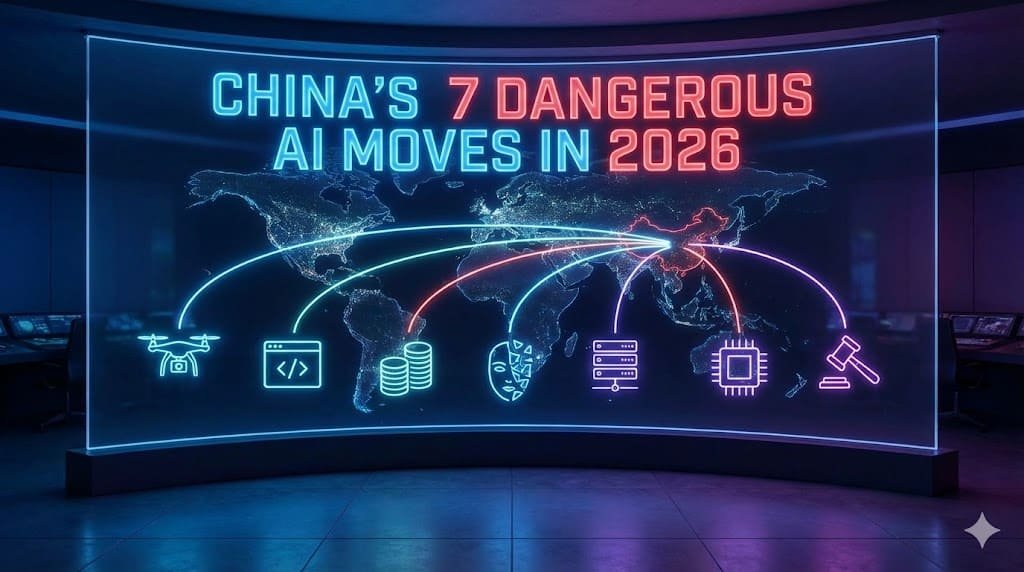
In 2026, China is no longer playing catch-up. They are executing a coordinated, multi-front offensive across seven distinct dimensions: military, commercial, economic, geopolitical, technological, regulatory, and psychological. Together, this represents the most aggressive and sophisticated national AI strategy deployed in human history.
If you track AI seriously, you need to understand all seven moves. Not as hype, not as panic, but as cold, hard structural reality. Here is my definitive breakdown of what is actually happening.
“The China tech shock is just getting started. It is the first time in history that an emerging market economy is at the forefront of science and technology.”
— Rory Green, Chief China Economist, TS Lombard, February 2026
Understanding ‘Intelligentization’ — China’s Third Military Revolution
To understand the danger, you need to understand the doctrine. China’s People’s Liberation Army has been modernizing in three sequential stages, each building on the last. The first stage was mechanization — acquiring modern weapons platforms and mobile firepower. The second was informatization — connecting those platforms to information networks, GPS, and digital command systems. The third, currently underway, is what Chinese military strategists call intelligentization (智能化).
Intelligentization is not a buzzword. It is a formal PLA modernization goal enshrined in national defense policy, referenced repeatedly by Xi Jinping since the 19th Party Congress in 2017, and now treated as the defining objective of Chinese military development through 2035. At the 20th Party Congress in 2022, Xi explicitly called on the PLA to ‘speed up the development of unmanned, intelligent combat capabilities.’ He has not set a new deadline — because, as analysts note, he no longer needs to. The work is already underway at scale.
What Intelligentization Actually Means on the Battlefield
The PLA’s vision is specific and alarming. Chinese military theorists believe that frontline human combatants will be progressively replaced by AI-directed systems — intelligent drone swarms, autonomous underwater vehicles, robotic ground units, and AI-assisted command systems that can process battlefield data at speeds no human officer can match.
At the PLA’s V-Day military parade in September 2025, this was on full display. The parade featured drone submarines — extra-large uncrewed underwater vehicles (XLUUVs) equipped with torpedoes — remote-controlled unmanned armored vehicles that can be air-dropped behind enemy lines, and robotic wolves operating in coordinated formation. Three entire parade formations were dedicated to information warfare: cyberspace operations, electronic countermeasures, and information support units. This was not a demonstration of aspiration. These systems are fielded.
More recently, a February 2026 report from the Center for Security and Emerging Technology (CSET) analyzed thousands of PLA procurement requests from 2023 to 2024. The researchers found active AI development programs across seven categories: intelligent autonomous vehicles, intelligence and surveillance systems, predictive logistics, electronic and information warfare, simulation and training, command and control, and automated target recognition. Perhaps most alarming: multiple procurement requests specifically sought AI systems capable of detecting U.S. naval assets, countering U.S. space-based systems, and supporting autonomous targeting decisions.
“Mass targeting means humans may not exercise judgement over the use of force.”
— Analysis of PLA ‘Intelligent Warfare’ doctrine, The Diplomat, February 2026
The Adoption Race — Why Diffusion Is the Real Danger
Most Western analysis frames the US-China AI competition as a technology race — who has the more powerful model, the better chips, the larger training runs. This is the wrong frame. The decisive variable is not capability — it is adoption. How quickly can a military organization move a promising AI capability from a research lab into actual fielded operations across the full force?
China’s answer to this question is structural. Through its Military-Civil Fusion strategy, the Chinese state has created legal and institutional mechanisms to appropriate private sector AI advances directly into PLA applications. There is no Chinese equivalent of the procurement bureaucracy, compliance reviews, and acquisition regulations that slow US military AI adoption. The Foreign Policy Research Institute put it plainly in a January 2026 analysis: China’s military AI momentum is dangerous not because it has better technology — but because doctrine, procurement, fusion, and mobilization are all pushing AI capability into the force at scale, simultaneously.
By mid-2026, forecasters at multiple defense think tanks predict China will begin consolidating its AI companies into a single unified national AI effort. When that happens — and it appears to be a matter of when, not if — the distinction between civilian AI research and military AI applications will effectively disappear. DeepSeek, Alibaba, ByteDance, Baidu, and Huawei will not simply be tech companies. They will be nodes in a national military-AI infrastructure.
AIVISIONEER VERDICT: This is not a future threat. It is a present one. The PLA is fielding AI-enabled autonomous weapons systems right now, at the same time it is building the legal framework to absorb the entire Chinese AI industry into a single national capability. The West is debating chip export controls. China is deploying drone submarines.
MOVE 02 — DeepSeek and the Open Source Trojan Horse
How DeepSeek Changed the Game in 2025 — and What Comes Next in 2026
To fully appreciate what is happening in 2026, you need to understand what DeepSeek actually did in January 2025 — because it was not primarily a technological achievement. It was a strategic one.
DeepSeek released R1, a high-performing reasoning model, as an open-weight model. Not open-source in the traditional sense, but open-weight — meaning anyone could download the model’s weights and deploy it on their own infrastructure, without paying DeepSeek, without an API contract, and without ongoing dependency on a Chinese server. The performance was competitive with OpenAI’s best models at the time. The cost to run it was roughly one-sixth to one-fourth of comparable American systems, according to a RAND Corporation analysis. The market reaction was immediate and violent: Nvidia’s share price fell 17% in a single session, erasing $593 billion in market capitalization.
The deeper danger, however, was not the market shock. It was what DeepSeek proved: that China could produce frontier AI under US chip export controls, at dramatically lower cost, and give it away for free. The commercial logic of American AI — charging premium prices for proprietary models — was suddenly exposed as fragile.
The Ecosystem Colonization Strategy
DeepSeek’s strategic brilliance was not accidental. Its parent company is a quantitative hedge fund — Liang Wenfeng’s High-Flyer Capital Management — which is structurally free from shareholder pressure to generate returns from AI. DeepSeek can prioritize research and open-source releases because it does not need to monetize them. Its American rivals — OpenAI, Anthropic, Google — are under enormous pressure to justify their capital expenditure through commercial revenue.
This asymmetry is now driving a fundamental shift in the global AI ecosystem. Hugging Face, the world’s most important open-source AI platform, is now dominated by releases from Chinese companies: Baidu, ByteDance, Tencent, Alibaba’s Qwen team, and startups like Moonshot AI. Chinese models comprised approximately 15% of global model usage by November 2025, fueled directly by the open-source push. That number is growing rapidly in 2026.
Once developers build production workflows around these models — integrating them into enterprise software, customer services, research tools, coding assistants — switching costs rise dramatically. The dependency deepens regardless of where the model originated. An enterprise running its internal systems on Qwen or DeepSeek is, in a very practical sense, dependent on Chinese AI infrastructure. The fact that the model runs on their own servers does not change the origin of the training data, the architecture choices, or the values embedded in the model’s behavior.
Chinese model cost vs US equivalents: 1/6th to 1/4th the price RAND Corporation analysis, January 2026
Chinese models on Hugging Face: ~15% of global model share November 2025, growing rapidly
Doubao (ByteDance’s chatbot) weekly users: 155.2 million QuestMobile data, February 2026
The 2026 Model Escalation — What Is Coming
If you thought 2025 was disruptive, 2026 has already escalated. Just ahead of the Lunar New Year in February 2026, the Chinese AI industry coordinated what can only be described as a synchronized product launch offensive. Alibaba released Qwen 3.5 — a multimodal model capable of analyzing two-hour videos, supporting agentic task completion, and priced 60% cheaper than its predecessor. Zhipu AI released GLM-5, a model it claims was trained entirely on Huawei Ascend chips, achieving what it calls ‘full independence from US-manufactured semiconductor hardware.’ ByteDance unveiled Doubao 2.0 and Seedance 2.0 simultaneously. MiniMax released M2.5.
DeepSeek has not yet released V4. When it does — and the model’s GitHub repository already shows the new architecture identifier ‘MODEL1’ as its foundation — analysts expect another market-disrupting performance. Alibaba has committed $53 billion to AI infrastructure. Alibaba alone has pledged 380 billion yuan — approximately $52 billion — to cloud computing and AI over the next three years.
The battle is no longer between individual models. It is between ecosystems. ByteDance is embedding AI into the content and productivity tools used by hundreds of millions of users. Alibaba is turning its Qwen chatbot into a shopping assistant embedded directly into the world’s largest e-commerce platform. Tencent is integrating AI across its enterprise software and the WeChat social infrastructure used by 1.3 billion people. The battleground has shifted from benchmark scores to infrastructure control.
“The surprise would be if some of these new models end up being underwhelming.”
— Alfredo Montufar-Helu, Managing Director, Ankura Consulting Beijing, February 2026
AIVISIONEER VERDICT: DeepSeek’s open-source strategy is not generosity. It is colonization. By making Chinese AI free to deploy, China is planting its technology in the foundation layer of global software. Once those roots are in, they are very hard to pull out — regardless of what chip export controls or sanctions come later.
MOVE 03 — The $8.69 Billion National AI Fund — State Capital Without a Business Model
How Beijing Is Funding the AI Race Differently from Silicon Valley
While American technology executives debate whether their $700 billion in combined AI capital expenditure will generate adequate returns — a debate serious enough to erase a trillion dollars from US tech market caps in a single week in early 2026 — Beijing is operating under an entirely different logic.
China quietly launched a national AI fund worth 60.06 billion yuan, approximately $8.69 billion, in 2025. This is not a venture capital fund looking for 10x returns. It is state-directed industrial capital with a single strategic objective: ensure China wins the global AI race, by whatever means necessary, at whatever cost necessary.
The fund exists alongside a separate set of structural advantages. Chinese AI companies receive energy subsidies that reduce the cost of running data centers — particularly significant given the enormous power consumption of modern AI training runs. They receive vouchers for cheaper compute access. They operate under regulatory fast-lanes that allow faster product deployment than most Western jurisdictions. And they have Xi Jinping himself as their most powerful advocate, with Premier Li Qiang personally chairing government study sessions on AI in February 2026 and calling for ‘large-scale commercial application’ of AI across China’s economy.
The AI+ Strategy — Embedding AI Across Every Sector
Beyond the fund, Beijing has initiated what it calls the ‘AI+’ strategy — a national program to integrate AI across every sector of China’s economy, society, and governance. This is not a technology policy. It is an industrial transformation mandate touching manufacturing, agriculture, healthcare, education, financial services, transportation, urban planning, and national security simultaneously.
The scale of China’s energy infrastructure advantage compounds this strategy. China has added more power generation capacity in the past four years than the United States has in its entire history, according to Bloomberg data. This means that data center construction — the fundamental constraint on AI training at scale — faces far fewer energy supply bottlenecks in China than in the US or Europe. While American hyperscalers fight for grid connections and power purchase agreements, Chinese AI companies can build.
Microsoft President Brad Smith noted in February 2026 that American tech companies ‘should worry a little bit’ about the subsidies Chinese competitors receive from their government. That is a careful diplomatic statement. The more blunt version: US AI companies are competing against an adversary whose capital does not need a business model, whose energy costs are subsidized, and whose regulatory environment is tailored to maximize speed of deployment.
China’s national AI fund: $8.69 billion (60.06 billion yuan) state-directed, no commercial return requirement
Alibaba AI investment commitment: $52 billion over 3 years cloud computing and AI infrastructure
Power capacity added by China (4 years): More than total US historical capacity Bloomberg, January 2026
US hyperscaler AI capex (2026): Up to $700 billion combined Amazon, Microsoft, Meta, Alphabet
Why ‘No Business Model Needed’ Is the Most Dangerous Part
There is a common misconception that state-directed capital is inefficient and therefore ultimately harmless. This has been repeatedly disproven in the semiconductor industry, the electric vehicle sector, and now in AI. State capital does not need to be efficient. It just needs to win market share long enough for the effects to become irreversible.
Consider the strategic sequence: Chinese AI companies, backed by state capital, can price their products below cost. Developers globally adopt the cheaper option. Ecosystem dependencies form. Then, years later, when alternatives have been crowded out, the price — or the terms of access, or the data requirements — can change. By that point, the switching costs are prohibitive.
AIVISIONEER VERDICT: The $8.69 billion fund is not China’s ceiling. It is its floor. Combined with energy subsidies, regulatory acceleration, and Xi Jinping’s personal political commitment to AI supremacy, state capital is being deployed at a scale and with a patience that no private company can match. The business model comes later. The market share comes first.
MOVE 04 — Seedance 2.0 and the Deepfake Acceleration
What Just Happened — and Why Hollywood’s Reaction Missed the Point
On February 13, 2026, ByteDance officially released Seedance 2.0. Within days, the internet was flooded with photorealistic AI-generated videos: Tom Cruise and Brad Pitt in hand-to-hand combat on a rubble-strewn rooftop. Donald Trump fighting kung-fu combatants in a bamboo grove. Kanye West dancing through a Chinese imperial palace while singing in Mandarin. These videos were realistic enough to fool casual viewers and sophisticated enough to go massively viral.
Hollywood reacted with fury, demanding ByteDance address intellectual property violations and unauthorized use of celebrity likenesses. ByteDance issued a statement pledging to ‘strengthen safeguards.’ This is the wrong conversation to be having. The real question is not about Tom Cruise’s likeness rights. The real question is: what happens when this technology is applied to disinformation, election interference, financial fraud, or military psychological operations?
The Capability Leap That Makes This Different
Seedance 2.0 is not incrementally better than its predecessors. It represents a step-change in AI video generation quality. The model was explicitly designed for professional film production. ByteDance’s own marketing positions it as a tool for creating cinematic content indistinguishable from real footage. It generates video in minutes from text prompts or reference images. It requires no filmmaking expertise, no studio infrastructure, and no budget beyond API access.
To understand why this is dangerous, consider what it now costs to produce a convincing video of any public figure saying or doing anything. In 2020, creating a convincing deepfake required weeks of work by a skilled technical team. In 2023, it required hours and a moderate level of expertise. In 2026, with Seedance 2.0, it requires minutes and a text prompt. The cost of disinformation production has dropped to near-zero. The quality has risen to near-professional.
This capability is being deployed into a world with essentially no detection infrastructure at equivalent scale. The Cyberspace Administration of China cracked down on unlabeled AI-generated content in February 2026, penalizing more than 13,000 accounts and removing hundreds of thousands of posts. But enforcement is described by analysts as inconsistent and uneven, struggling to keep pace across different apps and platforms. Outside China, regulatory frameworks for AI-generated video are in even earlier stages.
“The more capable these apps become, automatically, the more potentially harmful they become. It is a little bit like a car. If you build a car that can drive faster, that also means you can crash faster.”
— Rogier Creemers, Assistant Professor of China Studies, Leiden University, February 2026
The Geopolitical Dimension
The danger of Seedance 2.0 extends beyond individual viral moments. At the state level, AI-generated video at this quality threshold is a weapons-grade disinformation tool. A government actor — or a non-state actor with API access — can now fabricate credible video evidence of political events, military incidents, or diplomatic statements within minutes. The implications for Taiwan Strait tensions, South China Sea disputes, or electoral cycles in democratic countries are severe.
There is also a subtler danger. ByteDance’s global reach through TikTok means that Seedance 2.0-generated content can be distributed to billions of users through an algorithm that the company controls. Even with ostensible content moderation, the combination of production capability and distribution infrastructure in a single Chinese-owned company is unprecedented in its potential for influence operations at scale.
China’s domestic regulation mandates that AI-generated content be labeled. Those rules apply to the Chinese domestic internet. They do not apply to content distributed through TikTok in the United States, Europe, Southeast Asia, or anywhere else.
⚠ CRITICAL RISK: The same model that generates viral celebrity videos today will generate convincing fake military footage, fabricated political statements, and fraudulent financial communications tomorrow. The only difference is the prompt.
AIVISIONEER VERDICT: Seedance 2.0 is not a creative tool with some misuse risks. It is an industrial-grade synthetic media production system with genuinely creative use cases. The distinction matters because it determines how we regulate it — and right now, we are regulating it at the creative tool level while its risks operate at the weapons system level.
MOVE 05 — Building the Chinese Tech Stack for the Whole World
Why the Global South May Choose China — and What That Means
Here is the move that receives the least attention in Western analysis, and may ultimately be the most consequential: China is not building AI for its domestic market. It is building a complete, end-to-end technology infrastructure — 5G networks, AI models, cloud services, batteries, solar panels, chip hardware — designed for global export, priced for global adoption, and financed with Chinese state capital.
TS Lombard’s Rory Green made the strategic logic explicit in February 2026: China is pairing ‘dominant-market level tech with emerging-market production costs.’ For the developing economies that constitute the majority of the world’s population and land mass — and that do not have the same national security concerns about China as the US and Europe — the choice is straightforward. Low-cost Chinese technology with competitive performance and favorable financing terms, or significantly more expensive Western alternatives.
The Trade Network Already in Place
China is the top trade partner for the majority of the world’s nations, particularly in Africa, Southeast Asia, Latin America, and the Middle East. Those trade relationships already carry technology investment, infrastructure financing under the Belt and Road Initiative, and political influence. The AI layer is being added on top of an existing commercial and diplomatic network that took decades to build.
Consider the practical sequence: a developing country has Chinese-built 5G infrastructure, Huawei network equipment, and BRI-financed data centers. The local government then adopts Chinese AI tools for public services — facial recognition for city surveillance, agricultural AI for crop management, AI administrative tools for government efficiency. Each adoption deepens the dependency. Eventually, the entire digital infrastructure of that country runs on Chinese technology. The data generated by that country’s population flows through Chinese systems. The AI models making decisions about that population were trained by Chinese companies according to Chinese values and interests.
Green’s projection: most of the world’s population could be running on a Chinese tech stack within five to ten years. This is not hyperbole. It is a description of a trajectory already in motion.
China as top trade partner: Majority of world nations particularly Africa, SE Asia, Latin America, Middle East
Huawei 5G infrastructure deployment: Active in 170+ countries as of 2025
Global Chinese model share (Hugging Face): Rapidly growing dominated by Baidu, ByteDance, Tencent, Alibaba, Moonshot
The Data Sovereignty Consequence
A world split between a Chinese tech sphere and an American tech sphere is not just a geopolitical story. It is a data sovereignty story. AI systems learn from the data generated by the populations that use them. If most of the world’s population is interacting with Chinese AI systems, Chinese companies will be training the next generation of models on the behavioral data of billions of people outside China.
This creates a self-reinforcing dynamic. Better training data produces better models. Better models attract more users. More users generate more training data. The country that controls the largest and most diverse training data sets will have a structural advantage in AI that compounds over time — regardless of chip access, regardless of algorithmic innovation, regardless of raw compute power.
AIVISIONEER VERDICT: The Chinese tech stack strategy is the most patient and most structural of China’s seven AI moves. It does not require winning any single technological race. It simply requires being the cheaper, more accessible option for enough countries, for long enough, that the alternative disappears. That process is already underway.
MOVE 06 — The Chip Export Control Exploit
How a Policy Reversal Just Changed Everything
On January 13, 2026, the US Department of Commerce published a new regulation reversing previous restrictions on advanced AI chip exports to China. Under the Trump administration’s policy shift — announced in December 2025 — Nvidia H200 chips, AMD MI325X chips, and equivalent products from other manufacturers can now be sold to Chinese buyers under a new certification framework.
The Council on Foreign Relations’ analysis of this policy was damning: the regulation ‘acknowledges that exporting advanced AI chips to China poses serious national security risks, while simultaneously creating a pathway to permit their sale. The result is a framework that is strategically incoherent.’
Who Is Actually Buying These Chips
The framework is incoherent not just in theory but in practice. The most likely purchasers are Alibaba and Tencent for cloud infrastructure, and AI labs like DeepSeek for model training. These are precisely the companies with the most direct and documented relationships with China’s military and security services.
Tencent is not a peripheral case. It is formally listed by the US Department of Defense as a ‘Chinese Military Company’ — a designation that exists specifically to flag entities that support or supply the PLA. The new export regulation requires these companies to certify that chips will not be used for military purposes. The Council on Foreign Relations notes plainly that Commerce ‘has few means to prove that any certification is knowingly false or not being fulfilled.’
In practice, this means the US government is asking its own national security designees to sign a piece of paper saying they will not do what they are designated for. The paper offers no enforcement mechanism, no verification protocol, and no meaningful consequence for violation.
The Math Is Staggering
One million H200 chips would increase the total AI compute installed in China in 2026 by 250% compared to what China could deploy using only domestic chips. Chinese companies had reportedly already placed orders for approximately two million H200s from Nvidia before the policy was formalized. If those orders are fulfilled, China’s AI training infrastructure would be transformed at a speed no domestic chip program could match — potentially doubling or tripling total available compute within a single year.
To put this in context: xAI’s Colossus data center in Memphis, Tennessee — currently among the most powerful AI training facilities in the world — runs on approximately one million H100 chips. One million H200s, shipped to China, would allow the creation of a data center of equivalent scale, operated by companies designated by the DoD as military suppliers, inside the territory of America’s primary strategic competitor.
H200 chips ordered by Chinese companies (reported): ~2 million units pre-policy formalization orders
Compute increase from 1M H200 shipment: +250% vs domestic-chip-only scenario Council on Foreign Relations, January 2026
Tencent’s DoD designation: Chinese Military Company formally listed
The Precedent Problem
Even if this specific policy is reversed, it has established a dangerous precedent. The logic embedded in the regulation — that chips already commercially available in the US should be exportable to China at some acceptable ratio — creates a framework that future administrations could apply to more advanced chips. Nvidia’s next generation after the H200 is the H100NVL. Then comes Blackwell. Then Rubin. Each time a chip generation cycles, the argument becomes: these are commercially available, so they should be exportable by the same logic. The line keeps moving forward. China keeps advancing.
AIVISIONEER VERDICT: This policy reversal is not a trade concession. It is a strategic gift — one that may have been purchased through diplomatic pressure, commercial lobbying, or simple policy incoherence. The chips will arrive. The compute will be used. The military applications will follow. And the precedent will be cited the next time the question arises about the next generation of chips.
MOVE 07 — Regulatory Capture as Geopolitical Strategy
How China Is Winning the AI Governance Race While the US Retreats
Of all seven moves, this one is the most misunderstood — because it appears, on the surface, to be a story about responsible governance. China is regulating AI. It requires disclosure when users interact with chatbots. It mandates labels on AI-generated content. It bans emotional manipulation by AI systems. It requires security reviews before deployment of new AI tools. These all sound like sensible safeguards.
They are also tools of state control, censorship infrastructure, political surveillance, and — critically — geopolitical standard-setting that China is actively exporting to the rest of the world.
The Regulatory Architecture China Is Building
China became the first country in the world to establish formal, specific regulations governing generative AI. Its domestic AI governance framework requires every AI company to register with the Cyberspace Administration of China, demonstrate that their products avoid risks including ‘psychological harm’ and ‘violations of core socialist values,’ and notify local government agencies before launching any new AI tools.
A new proposal in early 2026 goes further: humanlike AI systems — chatbots, AI agents, virtual companions — would be required to disclose their AI nature when users log in and again every two hours. AI systems engaging users emotionally would be banned from generating content encouraging suicide or self-harm. Users must be informed of their right to refuse AI-generated content recommendations.
These policies have genuine public interest rationales. China’s minor protection framework for online services — limiting time spent online, requiring child-friendly modes on devices — is described by researchers as ‘arguably one of the most effective and rigorous systems for minor protection in cyberspace.’ These are not purely cynical policies.
“China-watchers arguing that Beijing’s AI controls are dependent on its authoritarian government are peddling a stereotypical narrative.”
— Xuechen Chen, Associate Professor of Politics and International Relations, Northeastern University London, February 2026
The Dual-Use Nature of Governance Infrastructure
But the same technical infrastructure that enforces labeling requirements also enforces the requirement that AI systems ‘espouse core socialist values.’ The same registration system that ensures product safety also gives the state visibility into every AI tool deployed in China. The same review process that prevents harmful content also prevents content the Party finds politically inconvenient. The governance infrastructure is not separable from the censorship infrastructure. They are the same system.
The global danger is that China is not keeping this system domestic. Through its Global AI Governance Initiative and Global Data Security Initiative, China is actively promoting its model of AI governance internationally — particularly to the developing nations that are adopting Chinese tech infrastructure and may be inclined to adopt compatible governance frameworks. A nation running Huawei 5G, Chinese AI tools, and Chinese governance frameworks is, effectively, operating a Chinese-compatible censorship and surveillance stack.
The Strategic Vacuum China Is Filling
In January 2026, the Trump administration scrapped Biden-era AI safety proposals and threatened legal action against US states attempting to regulate AI. The US federal government has effectively withdrawn from AI governance — at precisely the moment China is accelerating its domestic governance framework and promoting it internationally.
This creates a strategic vacuum. Countries seeking guidance on how to regulate AI — particularly those without the technical capacity to develop independent frameworks — will look for a model to follow. China is the only major power actively producing and exporting one. The European Union’s AI Act provides an alternative, but it applies only within the EU and has no equivalent export mechanism.
The country that defines the global AI governance framework shapes which AI capabilities are permitted, which are banned, and what values AI systems are required to express. If that country is China, the rules of the global AI game will be written in Beijing.
AIVISIONEER VERDICT: Regulatory capture is the slowest and most durable of China’s seven AI moves. It does not produce immediate results. But a governance framework, once adopted and embedded into national law and institutional practice, is extraordinarily difficult to reverse. China is currently winning this race by default, because its primary competitor has unilaterally withdrawn from the field.
THE AIVISIONEER Director
These Seven Moves Are One Strategy
Read individually, each of these moves is significant. Read together, they reveal something more important: a coordinated, multi-domain strategy that is being executed with patience, resources, and political will that no private company — and arguably no democratic government — can currently match.
The military AI diffusion program provides the hard power foundation. The open-source model ecosystem captures the global developer community. The national AI fund ensures capital never runs out. Seedance 2.0 and equivalent capabilities build the synthetic media infrastructure. The global tech stack strategy secures the supply chain of users and data for the next generation of models. The chip export exploit acquires the compute needed to close the remaining performance gap. And the regulatory capture strategy ensures that when AI governance eventually arrives globally, its rules will be Chinese-compatible by default.
None of these moves are secret. They are being reported in real time by major news organizations, analyzed by serious researchers, and tracked by national security agencies. What makes them dangerous is not their invisibility. It is their velocity. Their coordination. And the West’s failure to mount a coherent, sustained response to any one of them — let alone all seven simultaneously.
“The most dangerous thing about China’s AI moves in 2026 is not any single move. It is that they are all part of the same strategy — and the strategy is working.”
What Serious Watchers Should Track in the Coming Months
DeepSeek V4 release: When it comes — expected sometime in the first half of 2026 — it will set the new performance and cost benchmark for the global AI market. Its architecture will tell us how far Chinese labs have progressed past US chip restrictions.
PLA AI procurement accelerations: The CSET database of PLA procurement requests is public and updated regularly. Watch for any significant increase in contracts related to autonomous targeting or decision-support systems — these would indicate a shift from experimentation to operational deployment.
Chinese AI market share outside China: Track adoption of Chinese models among enterprises and government agencies in Southeast Asia, Africa, and Latin America. This is the leading indicator for tech stack dependency formation.
US chip export policy developments: The January 2026 H200 policy is not final. Watch for congressional pushback, DoD commentary, and Nvidia’s reported shipment data. If large-volume shipments proceed, the compute gap between Chinese and American AI closes rapidly.
Governance framework adoptions: Watch for any nation formally adopting Chinese AI governance frameworks as the basis for domestic regulation. Each such adoption represents a permanent shift in that country’s AI trajectory.
AIVisioneer will continue tracking each of these seven moves individually in upcoming posts in our Eastern Land Watch series. If you are serious about understanding where this race goes — not just what happened yesterday, but what comes next — follow the series and join our waiting list for in-depth analysis.