
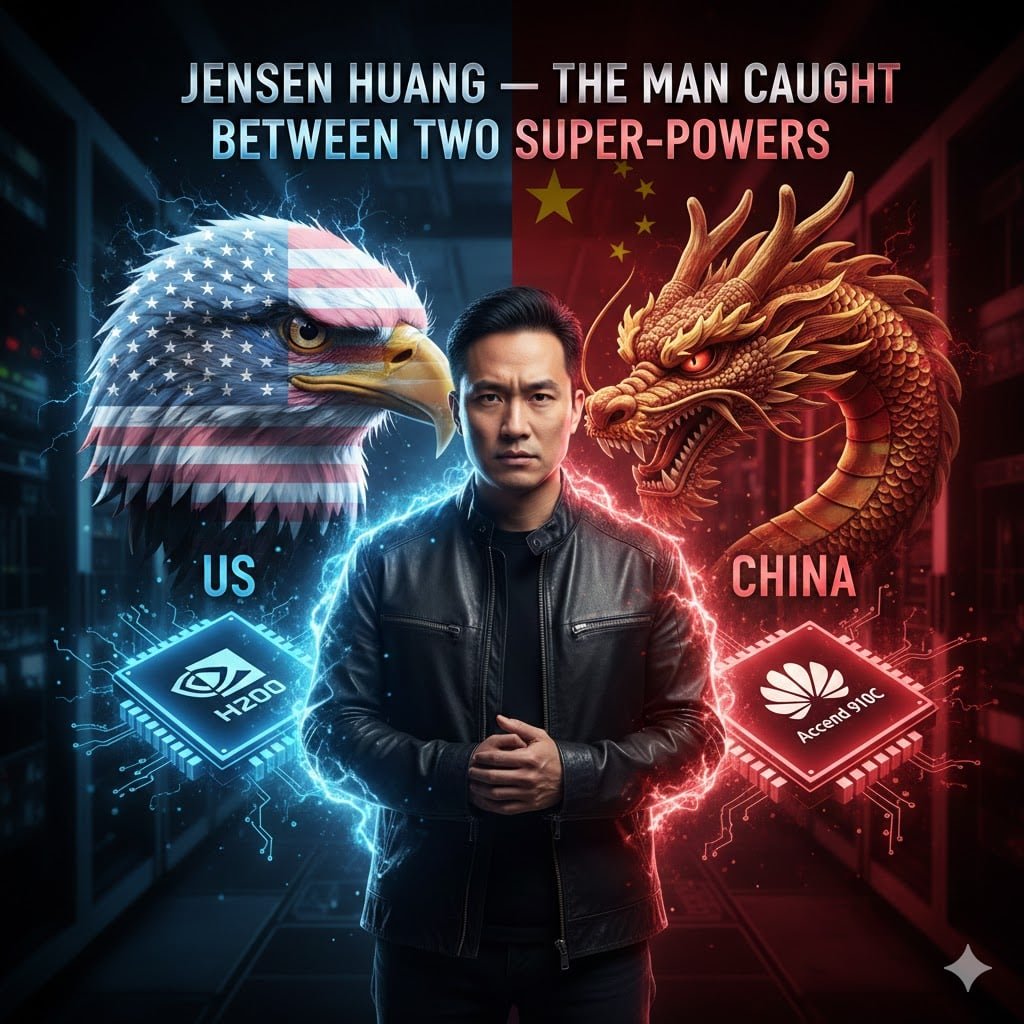

Jensen Huang — The Man Caught Between Two Super-Powers was sent to America at age 9 with nothing but a suitcase. He built the most powerful AI company on Earth. Now, two superpowers are tearing over his chips — and the future of human intelligence hangs in the balance.
It’s February 2026. The world’s most valuable company is caught in a war it never started. The man who built it holds dual citizenship from a country that doesn’t officially exist. And two nuclear superpowers US and China are using his chips as weapons. This is not a business story. This is the story of who controls the future of intelligence — and who gets left behind.
A Nine-Year-Old Boy With No English
In 1972, a small boy named Jen-Hsun Huang arrived in America. He spoke no English. He was nine years old. His parents sent him from Taiwan — not knowing that his uncle would accidentally enroll him and his brother into a reform school in rural Kentucky, thinking it was an affordable private school. Two small Asian boys, in a school built for troubled youth, in the American south.
Most people would be broken by that. Jensen Huang learned to be unbreakable.
Fast-forward 54 years. That same boy — now worth $164 billion — runs the company whose chips power virtually every serious AI system on Earth. OpenAI runs on his hardware. Google runs on his hardware. DeepSeek, the Chinese AI that shocked Silicon Valley, trained on his hardware. Every AI arms race in 2026 begins and ends with a chip that Jensen Huang built.
Here’s the uncomfortable truth that nobody in Washington or Beijing wants to say out loud: the most important man in the AI arms race was born in Taiwan, built his empire in America, and has been thanked personally by the CEOs of China’s biggest tech companies — Alibaba, Tencent, DeepSeek — for lobbying to get his own chips back into their hands.
He is not Chinese. He is not simply American. He is the living embodiment of the global future that both sides are desperately trying to own.
“China has about 50 percent of the world’s AI researchers, incredible schools, incredible focus in AI, lots of passion around AI. I think it’s a mistake to not have those researchers build AI on American technology.”
— Jensen Huang, CEO NVIDIA, 2025
The Chip War Nobody Planned For
To understand what’s happening right now, you need to understand the chaos of the last 12 months — because it reads less like a geopolitical strategy and more like a dark comedy of errors.
Trump bans export of NVIDIA’s H20 chip to China — a chip specifically neutered to comply with export rules. Chinese companies begin pivoting to Huawei’s Ascend 910C alternatives.
Ban reversed. H20 exports resume — but only after NVIDIA and AMD agree to give the US government 15% of all China revenue. China’s demand “never materializes.” The damage is done.
China’s CAC bans domestic tech firms from ordering NVIDIA’s new RTX Pro 6000D chip — one designed specifically for the Chinese market. Beijing signals: build your own or go without.
Trump announces H200 exports to China will be approved. Alibaba, ByteDance, and Tencent line up to order 200,000 units each. Beijing stays silent.
US Commerce Department formalizes H200 export rules — capped at roughly 1 million units to China, with 25% tariff payable to the US government, plus third-party chip verification requirements.
One day later, Chinese customs officials are instructed to block H200 imports. Chinese tech firms told not to buy unless absolutely necessary. NVIDIA stock slides. The world watches, confused.
What you’re watching is not two countries fighting over computer chips. You’re watching two civilizations fight over who gets to think faster.
And right now, neither side seems to be winning — because both are too busy trying to strangle the other to breathe themselves.
Related
DeepSeek Changed Everything
Then, in January 2025, something happened that no one in Washington predicted. A Chinese AI lab called DeepSeek released a model that matched OpenAI’s best work — and it reportedly did it at a fraction of the cost, on constrained hardware, because US export bans had forced their engineers to become more efficient.
Let that sink in for a moment. The restrictions designed to slow China down may have instead forced Chinese researchers to innovate around the problem — building leaner, cheaper, more efficient AI models while American labs were still throwing hardware at every challenge.
Strategic Reality Check
One million H200 chips shipped to China would increase the total AI compute installed there by 250% relative to if China relied solely on domestic chips. And yet China is still choosing to block them — betting that self-sufficiency, not dependency, is the winning move in a long game.
The Council on Foreign Relations described the current US export policy as “strategically incoherent” — creating a framework that either blocks nearly all exports (if implemented strictly) or fails to address any national security concern at all (if implemented loosely). Meanwhile, Beijing is playing chess while Washington plays checkers.
Related
The Real Arms Race: 2027 and What Comes After
Here’s the question that will define the next decade: Can China close the gap by 2027?
The honest answer is: maybe. And “maybe” is enough to terrify the people who run silicon valley and the Pentagon alike.
China has set a hard target for domestic AI chip self-sufficiency by 2027. Huawei’s Ascend 910C is already being deployed as an alternative to NVIDIA hardware.
Baidu and Tencent are diversifying away from American chips regardless of what export policy says this week, because no sane CTO in Beijing would bet their company’s future on the political whims of Washington.
The Scoreboard, February 2026
But here’s what the hawks in Washington keep missing: cutting China off from American chips doesn’t make those chips disappear from the AI race. It makes China build their own. And when China builds their own, at scale, for a domestic market of 1.4 billion people and 50% of the world’s AI talent — the math gets uncomfortable for everyone who assumed American hardware dominance was permanent.
The Weapon Nobody Talks About
There’s a deeper layer to this story that gets lost in the chip ban headlines. The most dangerous AI weapons in 2026 aren’t the chips. They’re the models — the algorithms trained on those chips, the agents being unleashed on the world’s systems, the autonomous intelligence that will soon make decisions humans can barely oversee.
Right now, the majority of frontier AI models are American. OpenAI. Anthropic. Google Gemini. But DeepSeek proved the model gap can close fast. And when AI agents become the standard interface for business, government, and military systems, the country whose models run in the most places wins.
Jensen Huang Is Trying to Tell You Something
NVIDIA went from 95% market share to effectively zero in China in under 18 months. Jensen Huang has been remarkably blunt about what he thinks of that outcome.
“We went from 95 percent market share to 0 percent, and so I can’t imagine any policymaker thinking that’s a good idea — that whatever policy we implemented caused America to lose one of the largest markets in the world.”
— Jensen Huang, CEO NVIDIA
This is the man who built the engine of American AI supremacy, saying out loud that America’s strategy might be self-defeating. And he’s right — not because he wants to sell more chips, but because he understands something that political strategists seem determined to ignore: you cannot contain an idea by banning a piece of silicon.
The boy who survived a reform school in Kentucky knows something about what happens when you put walls around people. It doesn’t break them. It makes them resourceful.
Related
Who Wins by 2027?
We’re going to give you a prediction that nobody in either capital wants to hear: there may be no winner.
Or rather — the winner won’t be a country. It will be the companies and researchers who transcend this geopolitical chess match and build the most useful, most trusted, most human-aligned AI systems. The institutions that focus on what AI can do for people rather than what it can do to the other side.
But in the medium term — 2027 and beyond — here’s the most likely scenario: China achieves viable chip independence through Huawei and domestic foundries, but remains 1-2 generations behind in raw compute. The US retains the hardware edge but bleeds talent and market access. And the real battleground shifts from chips to models, agents, and the data infrastructure underneath.
The AI arms race will not be won on a chip. It will be won by whoever builds the most indispensable AI ecosystem — the platforms that 8 billion people trust, use, and cannot imagine living without.
The Real Question No One Is Asking
Jensen Huang will turn 64 this month. The boy who arrived in America with nothing, who slept in a reform school dormitory and washed dishes at Denny’s, built the company that both superpowers are now fighting over.
He didn’t build it for America. He didn’t build it for Taiwan. He didn’t build it for China. He built it because he saw a vision of what computing could be — and he ran toward it harder than anyone else on Earth.
That’s the story the chip war keeps trying to bury. The future of intelligence doesn’t belong to borders. It belongs to the people willing to build it.
The only question left is: which side do you want to be on?