
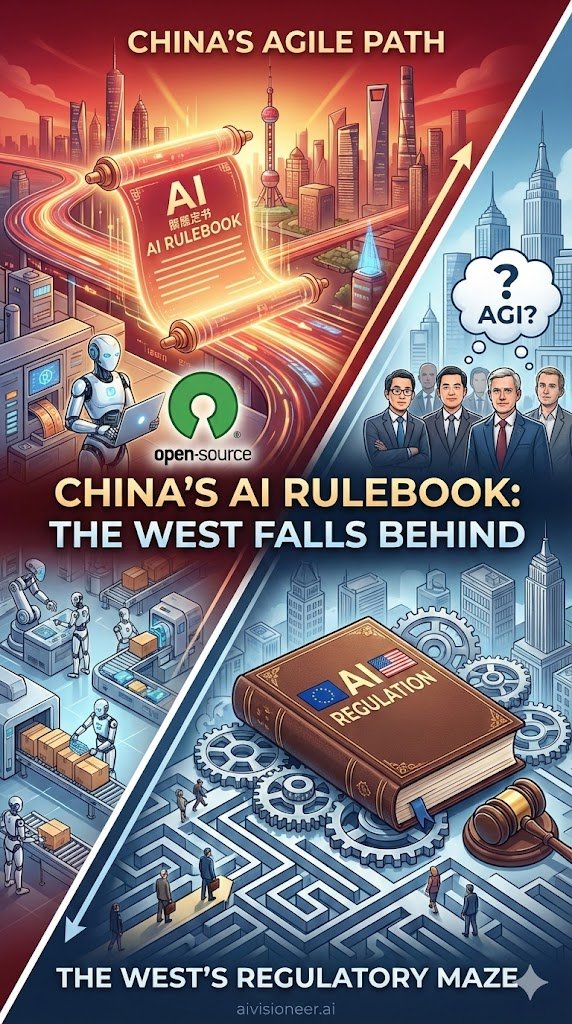

INTRODUCTION — The Wake-Up Call Nobody Saw Coming
- In January 2025, Chinese startup DeepSeek released its R1 model — and the world froze
- The release triggered what analysts described as a near $1 trillion stock market meltdown, wiping $600 billion from Nvidia’s market cap alone
- DeepSeek became the most downloaded app in the US within days — beating ChatGPT on its own turf
- US President Donald Trump publicly called it a “wake-up call” — an admission that American AI dominance was no longer guaranteed
- The bigger shock wasn’t the model itself — it was what it revealed: China had been quietly building an entirely different AI ecosystem, with its own rules, values, and ambitions
- This article argues the West isn’t just surprised — it is structurally, strategically, and regulatorily falling behind
1: China’s AI Blueprint — Built with Purpose
1.1 — The Master Plan: China’s 2017 Three-Step AI Strategy
- China launched a decade-long national AI roadmap in 2017 — match global standards by 2020, achieve breakthroughs by 2025, lead the world by 2030
- Unlike Western democracies, China’s top-down system turns long-term plans into actual execution — backed by budgets, mandates, and the full weight of the state
- By 2025, Phase 2 milestones are largely being met — something Western policymakers, who never had an equivalent plan, should find deeply alarming
1.2 — Regulation as a Tool, Not a Barrier
- China uses regulation to steer AI in the direction the state wants — not to slow it down
- Its layered rulebook — algorithm laws (2022), deepfake rules (2022), generative AI measures (2023), mandatory content labeling (2025) — moves from draft to enforcement in months, not years
- China issued as many AI requirements in the first half of 2025 as it did in the entire previous three years
1.3 — The State as Accelerator
- China doesn’t just regulate AI — it funds, deploys, and mandates its adoption at national scale, backed by an $8.2 billion government AI investment fund
- Local governments were ordered to adopt DeepSeek — one county reported a 90% reduction in approval times after deploying it across 20,000 workers
- The result: a whole-of-government AI strategy where the state is simultaneously regulator, funder, customer, and deployer
2: China’s AI Ecosystem in Action
2.1 — DeepSeek and the Efficiency Revolution
- DeepSeek trained its frontier V3 model for just $5.6 million — a fraction of the $100M+ OpenAI spent — proving that algorithmic innovation can substitute for raw compute power
- Cut off from Nvidia’s best chips by US export controls, China’s engineers innovated around the problem using a technique called “sparsity” — and reshuffled every Silicon Valley assumption in the process
- The message was clear: you don’t need the biggest chips if you have the smartest architecture
2.2 — AI in Everything: Cars, Phones, Hospitals, Courtrooms
- China’s real competitive advantage isn’t building better models — it’s deploying them faster and deeper into every sector of the economy
- DeepSeek is already embedded in China’s top EVs, all five major smartphone brands, hospital systems, government offices, and even the Supreme Court’s judicial AI model
- China’s philosophy: compete on applications first — who can best utilize AI — not just who can build the biggest model
2.3 — The Open-Source Strategy: Generosity as Geopolitics
- DeepSeek, Alibaba, and other Chinese labs are open-sourcing their models — undercutting Western proprietary labs on price and accelerating global adoption
- Chinese AI is already running inside Microsoft Azure, Amazon Bedrock, and Perplexity — embedded in Western cloud infrastructure
- It’s not generosity — it’s strategy: once developers build on Chinese models, switching costs rise and Chinese AI becomes the global default
3: The West’s Fragmented Response
3.1 — The EU’s AI Act: Strong on Safety, Slow on Speed
- The EU AI Act is the world’s first comprehensive binding AI law — intellectually rigorous, rights-respecting, and genuinely historic
- But its enforcement timeline stretches to 2027, compliance costs crush small companies, and it was designed before ChatGPT even existed
- The irony: it may become the global compliance benchmark — but it’s a standard the EU itself struggles to innovate under
3.2 — America’s Divided House
- The US has no federal AI law — only executive orders, agency guidelines, state patchworks, and voluntary commitments that shift with each administration
- The Trump administration’s 2025 AI Action Plan reversed Biden-era safety requirements in favor of deregulation, while Stargate — a private OpenAI/SoftBank/Oracle mega-deal — became America’s de facto AI strategy
- The AI Safety Index found no major US firm scoring higher than C+ on safety and risk policies — a damning indictment of American AI governance leadership
3.3 — Ethics vs. Execution: The West’s Costly Hesitation
- The West’s instinct to debate AI ethics before deploying AI widely is not wrong — but it is strategically costly when China deploys first and debates later
- Facial recognition, autonomous vehicles, AI in healthcare and education — in each case, China has deployed at national scale while Western nations are still in committee
- The West doesn’t need less ethical deliberation — it needs faster, smarter deliberation
4: Where the West Is Actually Falling Behind
4.1 — The Global Market Share War
- Chinese AI’s global market share surged from 3% to 13% in just two months after DeepSeek’s launch — capturing 20%+ share in 11 countries
- Global LLM usage tripled from 2.4 billion to 8.2 billion monthly visits between April 2024 and August 2025 — and China is capturing the growth
- Chinese models cost one-sixth to one-fourth the price of US rivals — a decisive, structural pricing advantage
4.2 — The Developing World Is Choosing China
- China’s AI is spreading fastest in Africa, Southeast Asia, and Latin America — regions the West has historically underserved
- Price, multilingual capability, and the Digital Silk Road — which bundles AI access into national development deals — give China an enormous structural advantage in the Global South
- In July 2025, China proposed a new global AI cooperation organization headquartered in Shanghai — a direct bid to institutionalize Chinese AI governance as the international standard
4.3 — Chip Controls: Slowing China or Fueling Innovation?
- US semiconductor export controls were designed to deny China the compute power needed for frontier AI — but DeepSeek proved you can build a world-class model on restricted chips
- The controls are still meaningful — they buy time — but they also incentivized China to accelerate domestic chip development, potentially eliminating the West’s most powerful leverage point
- The uncomfortable truth: chip controls are a defensive play. China is playing offense
5: Two AI Worlds on a Collision Course
5.1 — Different Values, Different Machines
- China’s AI regulations require models to align with “core socialist values” — shaping what AI can discuss, generate, and recommend at a foundational level
- Western AI is built on individual rights and open inquiry — producing fundamentally different products with fundamentally different assumptions about the relationship between citizens and the state
- As Chinese AI spreads globally through open-source and diplomacy, those embedded values travel with it — making this a soft power contest as much as a technology race
5.2 — The Global Governance Battle: Who Writes the International Rules?
- China is aggressively pursuing AI governance leadership at every international level — ITU, UNESCO, ISO, and its own proposed global AI body in Shanghai
- The West’s response is fragmented: the EU has the most credible framework but limited reach; the US has deregulated itself out of moral authority; and Western nations show up to governance forums as afterthoughts
- Whoever sets the global AI standards shapes the entire ecosystem — and China is playing the long game while the West hasn’t yet agreed on which game it’s playing
5.3 — One Global Standard, or Two Internets?
- AI risks producing a deeper split than the original Splinternet — not just blocked websites, but incompatible AI systems with different values, training data, and safety frameworks
- The emerging reality: a Western AI stack built on open-market principles vs. a Chinese AI stack spreading through open-source and the Digital Silk Road
- The window to prevent a permanent bifurcation is narrowing — the longer both sides build incompatible infrastructure, the harder convergence becomes
— Falling Behind Isn’t Inevitable, But the Clock Is Running
- The West isn’t losing because it lacks talent or capital — it’s falling behind because it lacks strategic coherence
- China’s advantage isn’t a perfect AI strategy — it’s simply having one, and organizing its entire government and economy around it
- The West must coordinate faster, regulate smarter, deploy more aggressively, and show up to the global governance fight — before the rules are written without it